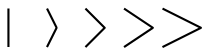
squares 1~5

squares 1~5

Tuesday, April 10, 2012

every shape is made of string

"In a black and white drawing the spaces are all white and all are bounded by black lines; in most oil paintings the spaces are multi-coloured and so are the boundaries; you cannot imagine a boundary line without any content, or a content without a boundary lines....therefore,when I speak of significant form, I mean a combination of lines and colours( counting white and black as colours)"
   (Bell "Art")
Seeing a line as a boundary line of content is perceptive seeing.
Seeing a line itself without content is sensitive seeing.
We can see an object and its two dimensional reproduction in the same way on sense level: the retinal images of both are two dimensional, which is why we can establish unified art theory for every thing we see.
 When we say that these shapes are same, it means we move the eye on both shapes in the same way.
Imagine the first one is made of string and the second of  a piece of wood.
We still can say that we see these things in the same way: we move the eye along the outline.
Seeing a shape is tactile: the finger can sense a shape along the contour.

Let me explain the eye movement using the model below: the line becoming wider and finally we see only one edge.
We can see a line because it has thickness, which means the line has two edges.
When the line is narrow both edges are seen at once which is the same as we see one edge.
When the line becomes wider we see the two edges, which is why we see the area.

Everything we see becomes a design network on the retina.
Every network is made of string.
The simplest network is a string and a closed string is a loop.
It can be said that a string is an element.
As atoms make a molecule and may become compound, string may compose more complicated patterns.

We can also start with a network as an element.
In this case a string or a loop is a broken network.
A network has countable strings and dots( meeting points of strings).
When two strings meet at a point, the result is a string.
Only when more than three strings meet at a point a dot appears
A dot is expressed as D(N), N=3,4,5....: dot with N strings.
As every design is made of string and dot, the eye counts the number of the strings and the dots when we see it.The model can be drawn on grid having the characteristics of proportion and angle.
For example D(0) type has only two models: 

Let me show some examples; there are many D(0) with two loops inside in Arp's paintings.


All the shapes belong to the same D(0) type with two loops inside:
Some of them look like creatures with two eyes, which is perception level of seeing.
Piaget wrote that young children acquire topological level of seeing at very early stage.
.I consider this is the beginning of sensitive seeing.
Associating two eyes which  consists of sensing and referring comes later.

The model works to classify alphabet:
There are ten types of models in this group.

D(0)


D(3)


2 D(3)


 D(4)


Not only the alphabet but any design has a string model.
For example using the two models above this new model can be made.
Imagine this is stretchable string then it is easy to make Arp's work bellow.

Many modern paintings originated from Cubism (including Constructivist painting, Dada ism painting) have distinctive types of string model, which suggests they belong to the same group.


"I wonder.... whether the appreciators of art and of mathematical solutions are not even more closely allied.... I have been inquiring why certain combinations of forms move us; I should not have travelled by other road had I enquired, instead, why certain combinations are perceived to be right and necessary, and why our perception of their rightness and necessity is moving."
     ( Bell)
Bell is showing which  direction I should go.

Friday, March 23, 2012

Unified art theory

I found this  image on-line recently.
My definition of art being any visually enjoyable image, this is an art work in my everyday life.
The original sculpture which is very likely to exist somewhere at this moment is as remote as a galaxy.
Art exists at the moment of seeing it.

The replica of this sculpture is the same as the original in appearance: the original work minus originality is the replica.
A free size model in any material can be made, which I call solid model.
From the model many single views can be made.
The Arp sculpture becomes reproductions, which I call flat model.
The digital image above belongs to this model.

The first prints in Western art history were produced as the reproduction of painting for public
and the oldest masterpieces of Chinese calligraphy exist only as copy.
They are considered to be art work.
Digital work is this century's reproduction and is art.

The flat model has colour and texture impression.
This model minus colour is black and white colour model.
The texture impression becomes small structure of its own as a roof can be covered with tiles.
Subtracting the tone from this model the design appears.
Now we reached what Vasari said in sixteenth century: design is the basis of all the art.


These lithographs below by Picasso belong to the same series which shows that abstract process happened within iconic level.
In the right one we can recognize a head, two horns, a body, four legs, a tail, and a male organ.
The elements of the shape are clearly recognizable: it consists of eight lines and three loops.

there are some good examples of art with totally definable geometrical characteristics in art history: Tangram; Ancient Roman letter design.
According to Wikipedia,
"The tangram is a dissection puzzle consisting of seven flat shapes, called tans, which are put together to form shapes.
The objective of the puzzle is to form a specific shape using all seven pieces, which may not overlap."
They say there are over six thousand five hundred shapes in the books published in nineteenth century.
It means that people in general can distinguish thousands of shapes easily and enjoy each of them.
I call this ability proto visual grammar.
this ability appeared as another pastime in Renaissance.
"The idea of geometrically rationalizing ancient Roman inscriptions became something of a pastime with Renaissance scholars. ....even Albrecht Durer published treatises on the subject, and the idea has been pursued, with varying amounts of success,
by artists and typographers ever since." (Wikipedia)

There is no art history but applied art history.
Pure art appeared occasionally when real artist among applied artists became aware of formal problem.
Serialists in music were very conscious of the significance of formal sound structure.
"In serialism the order of the twelve notes of the chromatic scale is determined pre-compositionally. The pitch rows are usually not repeated until the entire row has been played. However, pitches or a group of pitches can be repeated in succession. Total serialism extends the concept of serialism to rhythms, dynamics, tempos, meters and other non-pitch elements."
(Wikipedia)

Though some artists like Moholy-Nagy, Mondrian, Doesburg, Herbin, Max Bill used the formal method they were not aware of  using the same universal grammar which is like musical grammar.

Moholy-Nagy left the comment:
"In 1922, I ordered by telephone from a sign factory 5 paintings in porcelain enamel. I had the factory's colour chart before me and I sketched my paintings on graph paper. At the other end of the telephone, the factory supervisor had the same kind of paper, divided into squares. He took down the dictated shapes in the correct position. ...."(Experiment in totality)

Design with definably quantified geometrical characteristics belongs to perfect design model.
Let me start with an simple design: an ancient letter B; the type of B with two triangles attached on the right side of vertical line.
We need a line with certain thickness to draw any shape.
So I call it borrowed thickness.
All the visible geometrical characteristics are predetermined quantitatively and each characteristic is recognizable separately.
Removing one characteristic each time from the perfect design, we can conceive of the other models.

The proportion of the two triangles can be changed(proportion free model).
To recognize as B, the relative size of the two triangles should not be so different(partially proportion-free model).

The angles of the triangles can be various as long as the one side of the two triangles is aligned(partially angle-free model).
When all the angles are free the B-likeness disappears(angle free model).
A line can be curved like these:

I call this characteristic curved-ness.


These belong to the same group(curved-ness free model).

Tangram shapes are made of convexo-concave lines.
This puzzle suggests that convexo-cavity is essential to represent shape-likeness.

Without the smoothness of line, the shape can be drawn with shaky line or dotted line( smooth line free model =shape model).

Many artists used this type of line without sharpness, avoiding smooth line. Arp's relief with string is a good example.
Tapestry line and digital line are this type too.

The similarity of a triangle and a circle is being shape with no concave.
If a triangle is called a three sided polygon a circle can be called infinitely-sided polygon. These two belong to the same type of concave model.


Making a letter B with string on a sheet of paper, shake the paper a little.
It is no more readable as B but may look like two loops attached at a point.
The loops have  concavity( concave model).

Shaking further the loops loose tension and become loose strings attached at a point(string model).

Now there are seven models as total:
   Perfect model = Proportioned model
   Proportion-free model = Angled model
   Angle-free model =Curved-ness model
   Curved-ness-free model = Smooth line model
   Smooth line-free model = Shape model
   Shape-free model = Concave model
   Concave-free model = String model
Any design has these models and each model transformable to the next.
The transformation is reversible, starting from String model to Proportioned model.
The same idea can be expressed as diagram in two ways:


The ideas in my old blogs can be expressed as diagrams too.

Fine art is a sort of applied art.
Applied art is a sort of artefact
Artefact is a sort of natural object.


I see a bird drawing by Picasso(Art of code).
The bird looks like a white dove which is a symbol of peace( Art of symbol).
Without such knowledge it is still a bird(Art of icon).
With paying no attention on the semiotic content, I see the lines of the drawing(Art of form).


    Imagination is the faculty based on cognition.
    Cognition is based on perception.
    Perception is based on sense.
    To appreciate art formally only sense is necessary.


Each faculty makes its own world.
Sense makes art.
Perception makes physical world.
cognition makes real world.
imagination makes literature and religion.


C.S. Peirs says ethics is based on logic and logic is based on aesthetics.
I think aesthetics is based on visual grammar and visual grammar is based on sense.


Now I am ready to start establishing visual grammar.


Wednesday, December 14, 2011

upside down jade at the Met

The sense of tasting food with pleasure had been developed long before human created art of cooking.
Likewise the faculty of seeing a thing with pleasure appeared before making artifact.
seeing a shape is the subject to think about firstly, putting aside the idea of art.

Once I lived in New York.
One of my favorite artifacts in the Metropolitan Museum was an ancient Chinese jade with bird image, hanging upside down,being placed together with nearly a dozen of small jades in a show case.
Coming back to Japan, I found the digital image of this jade on-line recentry though I already have it as properly positioned reproduction in three different books.
Now I have three options of seeing this art work: 1 seeing the upside down original in the museum, 2 seeing the reproduction, and 3 seeing the digital image.

Collecting picture books was my passion in New York.
Now I recollect that seeing the original was not so important: the image was the one I wanted.
Collecting books is not so effective way: I often had to buy the whole book in order to get only one new reproduction.
As consequence I have hundreds of books on Klee.
This was the time before the whole catalogues of Klee were published.
The era of original art work had been outdated in my life and
it took some time to realize that the era of reproduction is going to be replaced by the era of digital image.

I trust my judgment of taste about art because it is based on my pleasure-giving collection.
And I think this neglected jade is a masterpiece.
I have found more than ten jades of this type: jade with animal image on rectangular format.
Seeing the original art works offered by the current art authorities are not big enough to give us clue to conceive solid art theory.
The memory of shape does not remain in our brain accurately.
Shape seeing is simple sense seeing, disconecting memory faculty.
To classify we need to collect many samples at hand, which no museum can offer.

This interesting upside down image on the right appeared accidentally, which suggests that the maker's intention is irrelevant for appreciation of shape.
To see the bird image it is upside down, but perhaps it is hanging properly as artefact because the hanging hole is on the lower part of the jade.
The design is interesting in both ways: one way is iconic and the other abstract.
The hanging condition tells us that the art authority considered this is an antique.
Perhaps the image had symbolic meaning but it was lost with the declined civilization.
Only if the viewer sees it's reproduction, the iconic meaning is noticeable.
The viewer who sees it as it is can enjoy the design in both ways.
So this object has four different statuses: collectible; symbolic artefact; iconic artefact; formal art.


Whenever I talked about art with people I noticed each person uses the word "art" in different meaning.
I suggest that art can be classified into four types of art: art of code; art of symbol; art of icon; art of form.
Most of art works have these four layers and each can be separated easily.
These are different mental activities.
Seeing an abstract image is not dependent on perception but on sense.
Sense can function alone undisturbed by the other levels: perception; cognition; imagination because sense-seeing is attentive foveal seeing.
The popular art theories skip sense level and stand on the other three levels, i,e. picture theory.
Here is the equation I introduced before: art= usefulness+ form.
The first three types of art serve for the usefulness: these work as sign an the form is not semiotic.
There are infinite shapes and original art should have new shape.
If the shape is new it cannot serve as a sign.

Later I found this method of classification is similar to Panofsky's: iconological; iconographical; pre-iconographical; pseudo formal analysis.
His interest is in the first two as the terms suggest and mine is in the last two.
So let me use my amateurish terms;

Art of code: to understand this type, we have to know the key code, like Morse code; to appreciate some contemporary art,we must join to the group called art world.

Art of symbol: this type is made for the contemporary who shares the same culture. The meaning is obvious for every member, like religious art.

Art of icon:  anybody with common sense can see what it signifies, like animal shape.

Art of form:  disregarding all the semiotic contents, we can pay attention on the shape of anything.

The last two are universal and perennial.
Here is a list of phrases and related terms classified into art of code, art of symbol, art of icon, art of form.

Art of code: iconology; art style; art history; any terms used as art words like fine art, modern art, primitive art; artist's manifest.

Art of symbol: iconography; religious motif; interpretation of art; reading art; "art symbol"; psychoanalysis of art.

Art of icon: pre-iconography; appearance; illusion; reality; photographic; space; figure-ground.

Art of form: pseudo-formal analysis; form; colour; tone; texture; concave; angle; round; "flat pattern"; colour patches".

In the era of digital image(art of form), image becomes free of the maker's intention(art of code).
I usually find interesting image(art of form) together not with similar shapes(art of form)but with the other similar images (art of icon) on the same page whenever I search on-line.
I may be able to collect images of this type of jade to make a big collection, which can be called digital museum.
Such a museum(art of form) is more advanced than the current museums(art of code).
Here we do not need art critics or museum people(art of code) but people to digitalize every image(art of form).

I also made a table to show the locations of these art types.


;

Wednesday, November 16, 2011

new formalism on sense

I have often written in the past log that  art is not what common notion says.
Such sixteen negative comments were picked and coloured in purple and were rearranged to make a new formalistic theory.

I defined art object as what we enjoy seeing: enjoyable  image, therefore
     The original art work is not necessary. 
     Being three dimensional is not important.
Seeing shape formally is seeing on sense, not on perception.
     Most adults do not see a shape on sense.
     Shape has no background.
     Shape has no orientation.
     Seeing shape is not binocular but monocular.
     Seeing shape is not three dimensional but two dimensional.
     Shape has no reality.
     Shape is not symbolic. 
     Colour is not as important as shape.
     This theory is not based on cognitive psychology
     but is located between cognitive psychology and  neurophysiology.
Being scientific,
     The degree of sensation is not important.
Being formal in ordinal sense,
     How it is made is not important.
     Who made it is not important.
     It has no history.

Now let me compare the new formalistic theory with Bell's theory.
I picked some sentences from Bell's formalism inWikipedia.
Then I coloured them in blue and gave each one my comment as new formalist.

It is an object's formal properties which make something art.
it is the geometrical characteristics of an object's image which make anything visually interesting.

Knowledge of the historical context of a painting or the intention of the painter is unnecessary for the appreciation of visual art.
There is no difference between art work and the other thing when the knowledge or the intention is irrelevant.
Anything can be art as long as the shape is interesting.

For Kant it  meant roughly the shape of an object-colour was not an element in the form of an object.
For Bell, by contrast, "the distinction between form and colour is an unreal one; you cannot conceive of a colourless space; neither  can you conceive a formless relation of colours."
The visual sense has two functions: one tactile for shape; the other optical for colour. 
The visual grammar is about tactile function:
 the eye moves along the contour like the hand moving it along.
Imagine that there are two triangles; the shapes are same but one in yellow and the other in blue.
we can easily recognise the shapes of these triangles are same.
Shape seeing means the fovea of the eye moves along the contour while the colour remains on the retina: shape seeing is different from colour seeing.
We can conceive a triangle without colour; the colour is variable and the shape is constant.

He also suggested that the reason we experience aesthetic emotion in response to the significant form of a work of art was that we perceive that form as an experience the  artist has.
We experience sensation in response to the quantified geometric characteristics of a shape.
"An expression of an experience of artist" is not relevant.

He also believed that "there is no state of mind more excellent or more intense than the state of aesthetic contemplation"....that works of visual art were among the most valuable things there could be.
Seeing shape with pleasure is one of the most intense instincts which made creatures survive and evolve.
Seeing shape makes men learn shape's a priori structural system, which becomes the standard model of all the other mental activities.

Now let me move to the quotations from Bell's writing"Art".

That there is a particular kind of emotion provoked by works of visual art, and that this emotion is provoked by every kind of visual art, by pictures, sculptures, buildings, pots, carvings, textiles, etc. etc., is not disputed....all these emotions are recognizably the same in kind....
The emotion provoked by seeing art works is the same as seeing any shapes; the difference is the degree of sensation.

...if we can discover some quality common and peculiar to all the objects that provoke it, we shall have solved what I take to be the central problem of aesthetics.
In each, lines and coloured combined in a particular way, certain forms and relations of forms, stir our aesthetic emotions....
"Significant form" is the one quality common to all works of visual art.
All visible things have shape and the common quality is geometrical characteristics of shape.
There is no common objective thing which distinguishes art work from the other shapes.
The term "significant" is irrelevant.

Any system of aesthetics which pretends to be based on some objective truth is so palpably ridiculous as not to be worth discussing....Aesthetic judgements are....matters of taste....
This flower is more beautiful: this is aesthetic judgement.
The judgement involves reference to memory: two activities.
Seeing a flower with pleasant feeling is sense-seeing: one activity.
Aesthetics on sense should be established firstly.
Sounds can be objectively notated though the effect of the sound to the individual may vary.
Musical grammar is the objective basis of musical aesthetics.

"Why are we so profoundly moved by forms related in a particular way?"....forms arranged and combined according to certain and mysterious laws do move us in a particular way.
The combination and arrangement of any limited number of shapes are finite.
The quantity of each characteristics of a shape varies.
The judgement which one is better among the same group of a combination belongs to the second stage of aesthetics.

In a black and white drawing the spaces are all white and all are bounded by black lines; in most oil paintings the spaces are multi-coloured and so are the boundaries; you cannot imagine a boundary line without any content. or a content without a boundary lines....therefore, when I speak of significant form, I mean a combination of line and colours( counting white and black as colours)
On sense level, there is no space inside the boundary line: we see only the line.
Space is perceivable on perception level.
The colour blind can see the boundary line therefore tone is the one to make the boundary line, which is the subject of neurophysiology.

It is not what I call an aesthetic emotion that most of us feel, generally, for natural beauty.
The retinal image of natural thing is like the photograph of the thing and naturalistic painting can be painted after the photograph, then the retinal images of those three things are almost the same .

I wonder....whether the appreciators of art and of mathematical solutions are not even more closely allied....I have been inquiring why certain combinations of forms move us; I should not have traveled by other roads had I enquired, instead, why certain combinations are perceived to be right and necessary, and why our perception of their rightness and necessity is moving.... the rapt philosopher, and he who contemplates a work of art, inhabit a world with an intense and peculiar significance of its own; that significance is unrelated to the significance of life.
In this world the emotion of life finds no place. It is a world with emotions of its own. 
I suggest that aesthetics should be divided into two: one grammatical; the other ,something like poetics, a sort of experimental aesthetics.
The grammar in linguistics is different from literature.
Likewise there is a priori visual grammar as a logical system of shape.
The look of everything is a pattern on retina, which may be the reason why the outside world look unified.
We intuitively learn the structural system which is based on the memory of shapes and it becomes the model of the other mental activity.
The world on sense is the world of pre-perception, of no reality.
There are four mental faculties: sense; perception; cognition; imagination.
each one is responsible to develop four different levels of the outside world; form; object ; the real(physical) world; the imaginative (metaphysical) world.

To appreciate a work of art we need bring with us nothing but a sense of form and colour and knowledge of three- dimensional space.
To see a cube or rhomboid as a flat pattern is to lower its significance, and a sense of three-dimensional space is essential to the full appreciation of most architectural forms.
Pictures which would be insignificant if we saw them as flat patterns are profoundly moving because, in fact, we see them as related planes.
If the representation of three-dimensional space is to be called " representation", then I agree that there is one kind of representation  which is not irrelevant.
Representational image seeing is on perception level, which may have additional effect of pleasure, nonetheless the image also can be seen on sense level.
There are many types of art work without three-dimensional space, which means that it cannot be the common factor.
The formalists missed a solid theory because they did not separate the two levels: sense; perception.
To write the musical notes after hearing sounds, musicians must be on sense level, in consequence they have musical grammar.


Thursday, October 6, 2011

art on sense, not on symbolic level

Popular science book readers know that everything in this world is made of stardust, with which more complicated materials like atoms, molecules, amino acids....life are made gradually, and then creatures with mental activity evolved.
Most of the steps can be explained scientifically and artistic activity, being on this line of progress, should be the same.
Lining up cosmology, physics, chemistry, bio-chemistry, physiology, neurophysiology, cognitive psychology, psychology, sense based formalistic art theory should be between neurophysiology and cognitive psychology.

Let me quote from Langer's"Philosophy in a new key".

"Quotation could be multiplied almost indefinitely, from imposing list of sources-from John  Dewey and Bertrand Russell....from....Piaget and Mead, Kohler....Cassirer, Whitehead, from philosophers,
 psychologists, neurologists and anthropologists to substantiate the claim that symbolism is the
 recognized key to that mental life  which is characteristically human and above the level of
 sheer animality-the use of sign is the very manifestation of mind. It arises as early in biological
 history as the famous "conditional reflex"....this is the real beginning of mentality."

The scholars seem to have more conditional habit than the ordinal.
My claim is that sense activity is the basic mental activity and conditional reflex is more advanced stage of mentality.
Conditional reflex is higher mental stage with two activity: sense; reference.
Whitehead says that he cannot dissociate the yellow colour from a yellow triangle but he does not have to.
There are two levels of seeing: retinal; foveal.
Paying attention on the three sides of a triangle one by one,we can see the triangle on the fovea and the colour is on the retina all the time without attention.
Act of sensing a shape pleasantly is not communication with symbol but receiving information of shape which everything has.
Accumulation of the memory of shapes may be the second stage of formal seeing, which start revealing a priori structural system of shapes.
This structure is the normative model of art, logic, geometry et cetera.
Without realizing that shape-seeing is  different from sign-seeing, all the current aesthetics were developed under the influence of those people.

Imagine that we reconstruct Pavlov's famous experiment using monkey this time: ringing a bell every time when we give him a banana, then the bell only can make him salivate.
A whistle could be chosen instead of the bell.
It means that any sound can be used as the signal: the bell is not always the symbol of banana.
Symbol can be anything for the same thing.
This is why symbolic level of art cannot be studied scientifically; symbol is accidentally picked, therefore is studied historically.
The taste of banana is different from apple.
Taste is universal, on which scientific theory may be established, likewise the shape of anything is the universal object to start a theory.

An organism developed sensory organ;first tactile one then visual one.
When the sensation became pleasure feeling, this is the beginning: the taste is good.
The second stage is that the taste is better: the act refers to the memory;  more complicated activities.
When we see unfamiliar wild flower in the field, we just feel it is beautiful.
We do not have to know the name.
When we see a new thing like new art, w can just enjoy seeing it unconditionally: seeing with no reference.
The thought that this is more beautiful comes immediately after seeing.
This is taste judgement which consists of three activities: seeing a flower and remembering the past experience of seeing the other flowers and comparing all.
Formal seeing starts as early as the stage Piaget called topological;earlier in biological history than conditional reflex.

The obvious consequence of art being on sense is that there is no art history.
Art historians ,relying on their taste, select art objects among artifacts to fabricate a history.
Artifact can be artistic because the maker has natural inclination to appreciate good shape,which does not mean that he  necessarily had intention to express some artistic feeling.
There is no use seeking the oldest art work since if we admit art work is visually interesting object,  the beginning of art appreciation is much older than making of so-called art.
The best we can do is finding oldest visually-interesting artifact and guessing that the maker already had such a good taste.
Actually there is no pure art work but artifact except some experimental modern art in  art history.
Although it seems that there is no interesting contemporary art going on, we now know  two wrong reasons : aesthetics is on the wrong foundation; art is dependent on  art history.
We can get back to the right track anytime.
What we should start with is the early abstract art  in the last century; they suggest proto-formal theory.


Wednesday, August 17, 2011

Art seeing is shape seeing

Seeing art is seeing shape.
The image on retina is solely responsible for pleasure of seeing shape.
The retinal image is two dimensional and nobody bothers a photograph not being the real object.
Photographs of architecture is not three dimension but still enjoyable to see them as architecture.
As we can see it from many angles,the photographs can be taken from many angles.
Three dimensional art is replaceable for many single two dimensional views.
This is what the retina is doing.

Decades ago I went to see some Gothic cathedral just to be disappointed.
The main reason is that I could not find any good shots of view
 as I expected.
I realized that the photographs in the book of the cathedral are well  taken with much effort beyond the capacity of unprepared tourist.
Architecture is the mixture of functional part and artistic part which must be discovered.
To see an object, we may walk around it but to see its shape we have to stop and fasten the sight.
The image must be static in order to see it's geometric characteristics.

Unless each viewer sees exactly the same image, sound art theory can not be established.
This may be the meaning of Kant's comment that art of garden is painting.
Vasari considered that painting is the major art of the three arts: painting;sculpture; architecture.

Even binocular vision may be problem to see shape.
An art student closes one eye to see the proportion of a model ,
and the proportion is the well known characteristic of shape to give us pleasure of seeing.
There is no wonder all the stereoscopic device failed to maintain the initial popularity.

Art seeing is monocular.
A bower bird has two eyes each on the side.
He makes an ornamented garden to attract female birds.
He must be able to enjoy his garden with one eye only.
I used to know one eyed artist in London and I believe that he has no problem to see things artistically.

It is possible that organism developed the visual sense organ with pleasure sensation before  monocular organ became binocular
 and that the binocular organ was preserved for the convenience of catching food.
The capacity  of seeing shape with pleasant sensation can be very primitive.


Thursday, August 4, 2011

Digital image art theory

Everything we see is projected on retina.
On this retinal image level a unified art theory can be established.
Digital image is the model of the retinal image in the theory.
The image is shape whose geometrical characteristics are responsible for sensory pleasure.
All  shapes constitute a structural system.
As the  system is timeless and not cultural,this art theory is timeless and not cultural.

Whenever I find an unusual wild flower (=natural object) I try to search it  online not only for knowing the name but for collecting the digital image (=artifact).
I collect images as music lovers do musical reproduction (=artifact).

The original art works (=fine art) we can see in our life time are only a fraction even if we spend all free time for it.
My collection of images consists of picture books (=artifact) and of digital images.
I want possess an image in order to enjoy it repeatedly because the enjoyment lasts only the moment of seeing.
Art seeing is pure sensing like tasting.
The pleasure of seeing any thing is the same type of sensory enjoyment for me.

The common denominator of all objects I see is the shape.
I extend the idea of art work as any visibly interesting object.
Art theory must be about natural object which includes artifact, which includes applied art, which includes fine art.

The original painting by Rubens is fine art and the print based on the painting is applied art.
What I see daily are the reproductions of the painting and of the print.
They are neither fine art nor applied art but artifact.
Though I collected mostly printed reproductions, digital images started to appear as collectible.

Reproduction was practically print work in the late twentieth century and now digital image is surpassing it.
Reproduction and digital image took over the original in daily life, replacing fine art.

Let me take an example of Picasso in my life.
Until 1990 my new collection of Picasso was mostly cutout pages of auctioneers catalogues.
In 90's I obtained the Picasso Project.
Now I mostly see a Picasso on On-line Picasso.

The small size of the digital image is minor problem for me as long as the shape is clearly seen.
Imagine that we see some figure at a distance when we are getting close to it.
We know we are seeing the same thing in spite of enlarging size, which suggests that the real size is not important characteristics of shape.

I may get several reproduction of the same picture.
They are printed in different color.
Which one is much similar to the original is not the point for me.
The important thing is that the new reproduction gives me different pleasure.
I have several reproductions of the same Matisse.

I occasionally found an upside down reproduction  which is interesting.
In the theory the maker is disregarded.
Only the image matters.

The quality of digital image has reached fully enjoyable state.
Being an original art work or the digital image is the same as being a book or digital book; being a live music or DVD.
It is likely that digital image is the medium of twenty first century art.
The consequence is that museum, commercial galleries and art schools are obsolete.
Art as digital image can be appreciated and studied by anybody anywhere anytime.
With more people involved, the study and creation of art will make progress.